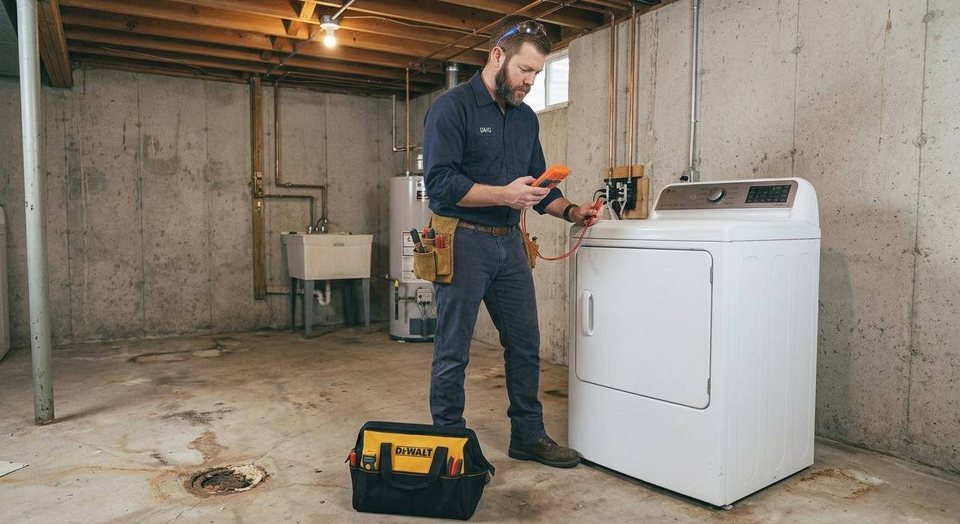
A dryer only has three jobs — make heat, move air, turn the drum — and the Loop tests them in that order at your home anywhere on the north-county route.
Half the dryers we see have already been "diagnosed" by a video: usually as a heating element, occasionally as a belt. The Loop doesn't argue with the internet; it just meters the circuit. Thermal fuse, cycling thermostat, element or igniter, coils on the gas valve — each station gets a reading before anything gets a sentence.
Airflow comes next, because a dryer strangled by its own duct will burn through parts forever. The technician checks temperature rise across the drum and back-pressure at the exhaust; if the duct is the real patient, the tally says so instead of pricing a part you don't need.
Drive problems — belts, rollers, idler pulleys, worn glides — announce themselves by sound. Thump, squeal or scrape, describe it on the phone and the van arrives with the likely kit already aboard.
On electric units it's usually the element or its fuse; on gas, the igniter or the coils. The Loop's meter says which — no parts roulette.
Heat without airflow is a duct problem wearing a dryer costume. We measure back-pressure before touching a single component.
Overheat trips, motor thermal cutouts and door-switch flutter all mimic each other. The circuit of checks separates them in minutes.
A belt fraying or a roller flat-spotting gets louder with a full drum. Caught early it's a cheap visit; ridden hard it takes the drum bearing with it.
Each stop on the route gets a page written for how this machine fails there:
Yes, both fuels every week. Gas work stays on the appliance side of the shutoff — igniters, coils, valves, sensors. Anything upstream belongs to the utility and we'll say so.
If the Loop shows the duct choking the machine, the tally includes clearing the run we can reach and says so as a line item in plain words — not a surprise add-on at the end.
Often, actually — older dryers are mechanically simple and parts stay available. The tally gives you the real figure, and if it crowds replacement cost the technician says that out loud.

Book the visit, watch the circuit run, read the tally — $85 flat if you stop there. Phone is quickest; the form gets a callback at the next opening.